The rulebook of the team match, as it is in the build submitted to the App Store. Numbers come straight from the game’s data.
In the game · 1.0
Applies to version 1.0describes the current gameUpdated:
§01
Teams and goal
Two teams of three couriers: ▲ Amber and ● Azure. Team colour always comes with a shape.
Each team has its own generator; it can’t be destroyed.
The arena has three neutral receivers. One is active each round, and the order is shown before the match.
Every pulse or spark delivered to the active receiver is one point. More points after three rounds wins.
§02
Rounds and overtime
A 3-second countdown, then 3 rounds of 45 s with 4-second breaks.
Between rounds, pulses and sparks in transit vanish, rails and bridges reset, resource refills, the score stays, and the next receiver becomes active.
A tie goes to overtime on the central receiver: up to 20 s, first delivery wins.
Simultaneous deliveries in overtime, or none at all, make it a draw.
§03
Rails
You lay a rail by moving from one grid node to the next. Laying is on by default; a toggle turns it off.
New rail costs 1 resource per metre. The reserve is 100 and refills at 10 per second shortly after you stop spending.
A rail lives 30 s after it was last laid or refreshed. Riding over your own rail with laying on refreshes it.
At most 80 m of active rail per player and 240 m per team; past that, the oldest pieces are removed.
Every piece of rail has one owner team. You can’t lay over an enemy rail — break it first. Rails of different teams never connect, and rails on different levels never join.
On your own powered rail you ride ×1.35 faster. Rails are not walls and do no damage.
§04
Power and pulses
Only the part of your network connected to your own generator is powered. A rail started elsewhere carries nothing.
Every 3 s, on a fixed beat from the start of the round, the generator emits a pulse — if a powered path to the active receiver exists at that moment.
The pulse travels at 8 m/s along the shortest powered path. It doesn’t split at forks; if its path is cut, it can re-route at a node.
Extra parallel routes keep deliveries going when one is cut, but they don’t raise the rate.
A pulse that arrives scores one point for the team that owns the rail.
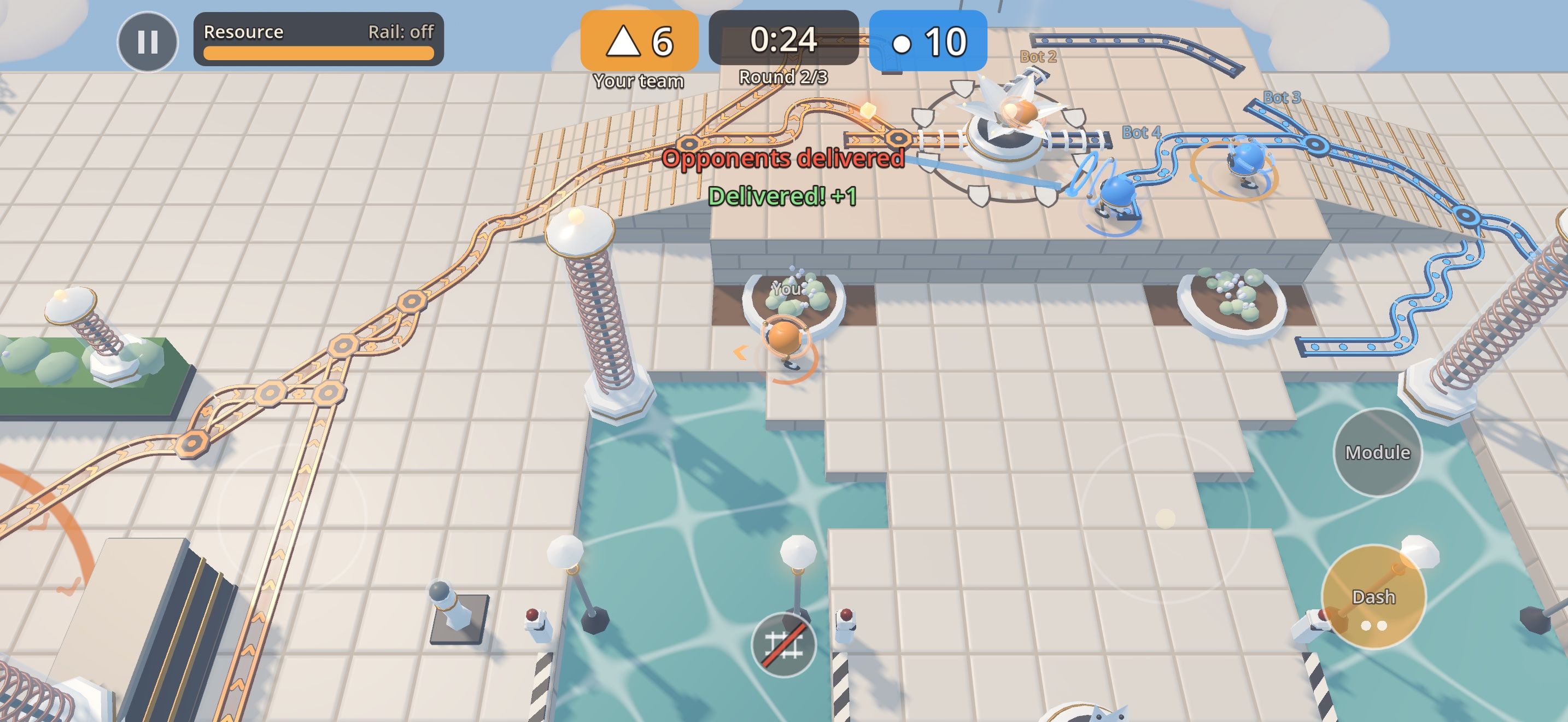
In-game screenshot
Coil Garden, round 2: both networks reach the raised receiver. “Opponents delivered”, then “Delivered! +1” — 6 : 10.iPhone 17 Pro Max · development build, 3 Oct 2026 · bots
§05
Cutting and sparks
The pulse tool sends a wave up to 6 m along the ground. It stops at the first wall, ledge or hit and never changes level.
A broken piece of rail sparks for 1 s; after that it can be laid again.
A pulse whose path breaks or loses power drops as a spark.
Anyone can pick up a spark — just touch it. To deliver it, stay inside the active receiver’s ring for 0.4 s.
Delivering the other team’s spark is an interception: the point goes to the team that delivers.
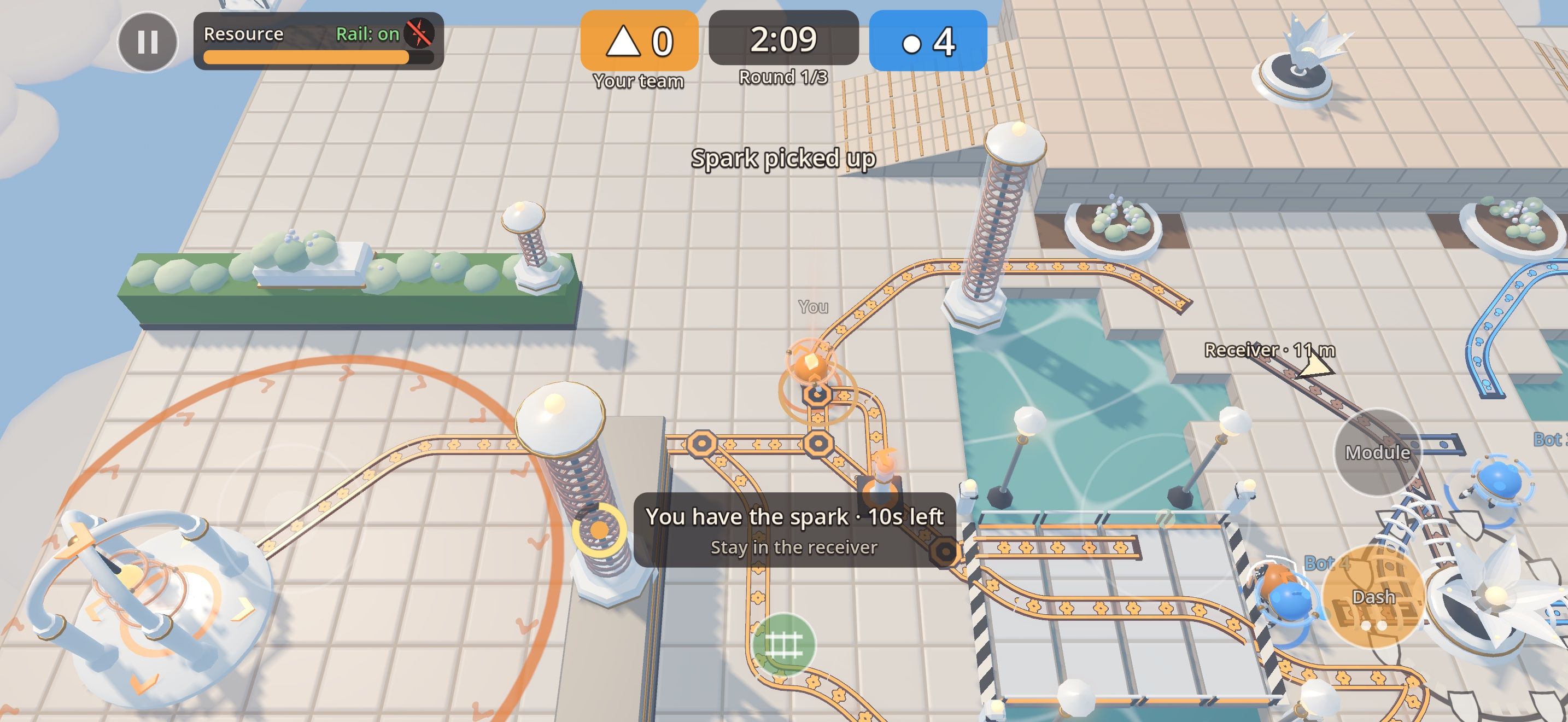
In-game screenshot
Coil Garden, round 1: the courier has picked up a spark and heads for the receiver, 11 m away — “You have the spark · 10s left”.iPhone 17 Pro Max · development build, 3 Oct 2026 · bots
§06
Protected zones
Receiver guard: rails of both teams within 1.6 m of the active receiver can’t be broken. The fight happens on the approach.
Base zone: inside your own start zone you can’t be hit, and your own rails there can’t be broken.
GeneratorCut hereSparkReceiverGuard 1.6 m
Diagram · drawn for the website
§07
Bridges
A bridge opens when a powered rail reaches its terminal — and it opens for everyone, rivals included.
It stays open while any team powers one of its terminals.
When the power is lost, it warns for 3 s, then closes; pulses on the deck drop.
Coil Garden has one bridge, Cloud Wharf two, Weaving Yard none.
§08
Couriers
Dash covers about 3 m; a charge comes back in 4 s.
A jump clears short gaps, but only at the arena’s marked jump spots.
Three hits overload a courier: it drops any spark and returns to its start after 3 s. Nobody scores for it.
Speed, resource and power are the same for everyone. Appearance never changes speed, size or signal visibility.
§09
Modules
One module is picked before the match. All three are available from the start; none gives a permanent advantage.
ModuleWhat it doesNumbers
Pulse StepEscort and interceptA second dash charge; charges recover one at a time.2 charges · 4 s each
InsulatorRoute defenceShields one of your rail segments from breaking.3 s · cooldown 12 s · reach 6 m
JumperQuick repairRestores a recently broken section of your network; ride over it with laying on to make it permanent.up to 4 m · 4 s · cooldown 12 s · reach 8 m
§10
Bots
Bots follow the same rules and send the same kind of inputs as a person.
They are always labelled BOT and are never passed off as people.
Three difficulties — Easy, Normal, Hard. Harder bots react faster and plan further ahead; they never get more speed, resource or power.
Practice with bots works offline: you and five bots, two on your side and three against you.
§11
Online rooms
Quick match looks for players; bots fill the empty slots, and you see how many before the start.
Or create a room: share its code, friends join by code, and the host starts the match. The host can fill empty slots with bots and pick their difficulty.
The server decides the score, the timer and the result.
If you’re away for 5 seconds, a bot drives your courier until you’re back. After a lost connection you can rejoin within 20 seconds.
One official server, in Frankfurt (Germany). No account, no sign-in, no chat.
Player names: up to 16 characters. You accept the name rules before your first online game, and every name is filtered on the device and again on the server. Report a name (it opens an e-mail to the developer) or block it on your device.
§12
After the match
The results screen lists Energy delivered first, then Interceptions, Routes restored and Support.
“Watch the key moment” replays the decisive play when there was one: an interception and delivery, a rescued spark, a last-second or overtime delivery.
A rematch is offered — with no ads on the way to it.
These rules reflect the first balance pass of version 1.0; numbers may change in a later update. If the game and this page ever disagree, the game is right.