Guide 01 · First match
How to send your first pulse
Start at your own generator with rail laying on and ride to the active receiver — the rail follows you. Once it links the two, the generator sends a pulse on its next beat (every 3 s). The pulse rides the rail by itself at 8 m/s and scores one point when it arrives.
01 / Step by step
Six steps to +1
Start at your generator
Each team has its own generator — yours is in your team colour (▲ Amber or ● Azure). Power only flows from it, so a rail you start anywhere else carries nothing until it joins your team’s network. The game says it plainly:
Start at your generator — power only flows from it
.Check that laying is on
Laying is on by default. Next to the Resource bar you’ll see Rail: on; on a touchscreen the switch is the small round button at the bottom centre. When it reads Rail: off, you leave no rail behind you.
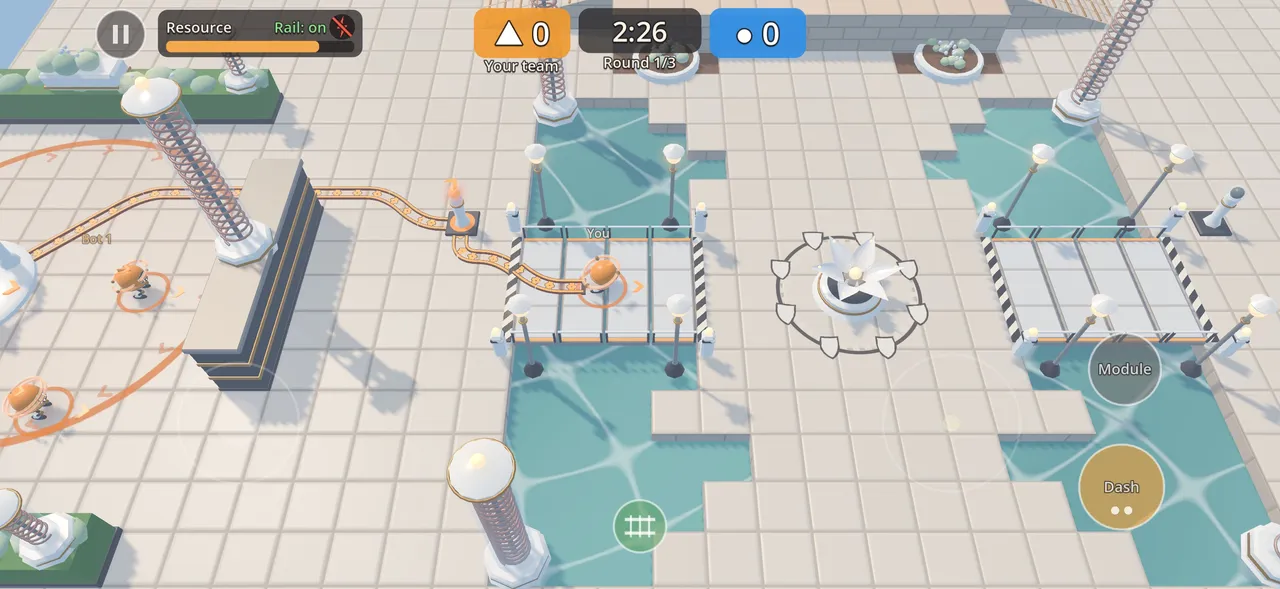
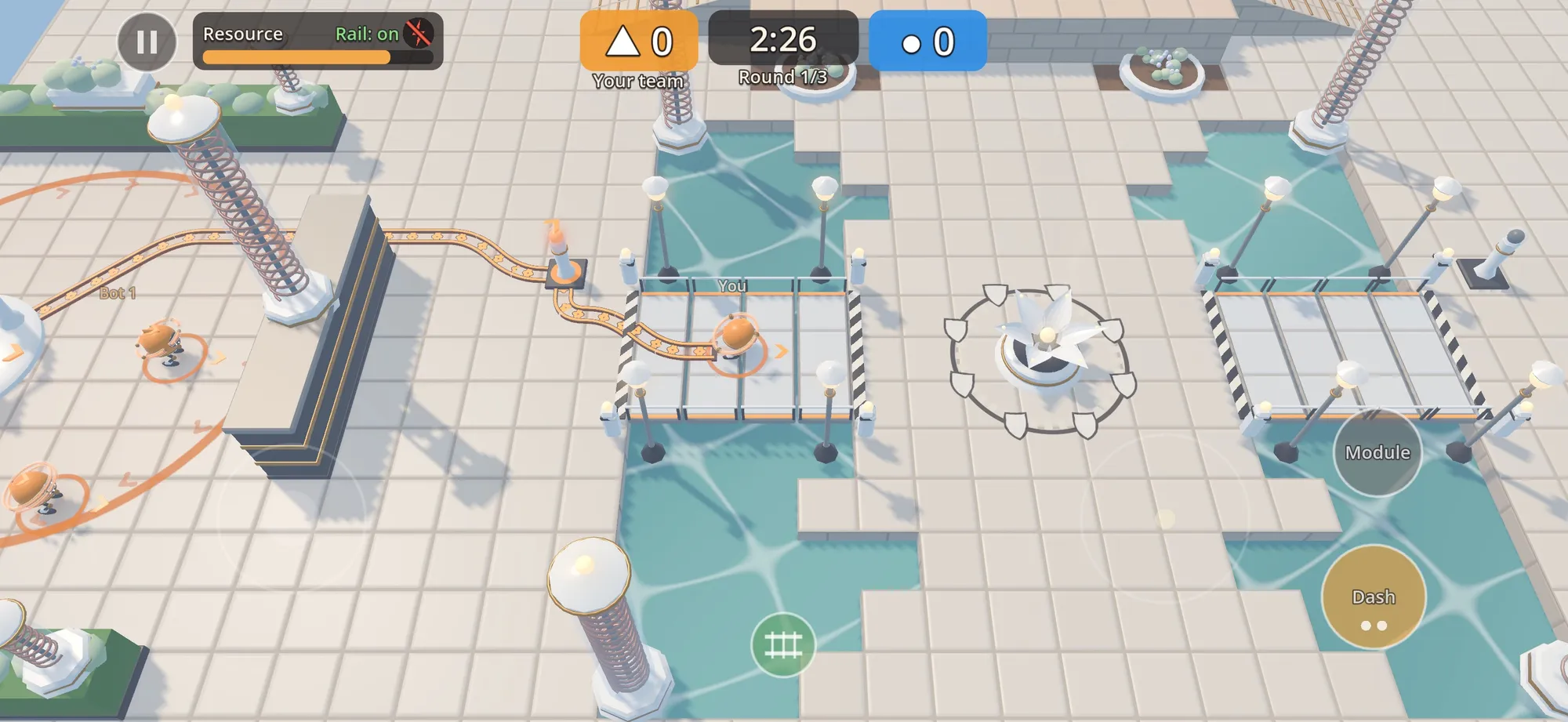
In-game screenshot · iPhone · development build, 3 Oct 2026 · botsCoil Garden: your courier (“You”) lays amber rail across a bridge. Top left — the Resource bar and “Rail: on”; bottom centre — the round laying switch.Open the full frame — In-game screenshot on Coil Garden: an amber courier laying rail across a bridge between two ponds; HUD shows Resource and “Rail: on”. Ride to the active receiver
Just move: every step to a neighbouring point of the arena lays the next piece of rail. Follow the arrow Receiver · 11 m at the edge of the screen. Only one of the three receivers is active in a round; during the break the next one is marked on the arena. A jump lays nothing, so it leaves a gap.
Mind the resource
New rail costs 1 resource per metre from a reserve of 100. It refills at 10 per second once you have spent nothing for 0.8 s. The shortest generator-to-receiver routes in 1.0 are 21–34 m, so one full reserve covers any of them in a single run. If it runs dry, you’ll see No resource and laying simply stops.
Diagram · real numbersAt 1 per metre, the shortest routes in 1.0 (21 m on Weaving Yard to 34 m on Cloud Wharf) use about a fifth to a third of the 100-unit reserve. It refills at 10 per second once you stop spending. Wait for the beat
The generator doesn’t fire the moment you connect. It sends pulses on a fixed beat — every 3 s, counted from the start of the round — and only if a path exists at that moment. A fresh connection can wait up to 3 s. In the tutorial this is the moment of
Connected! Watch the pulse ride in
.Diagram · real numbersExample: you connect 7.2 s into the round on a 24.7 m route. The next beat is at 9 s; the pulse arrives about 3.1 s later. After that a new pulse leaves every 3 s while the path holds. A pulse still on its way when the round ends is lost without a point. Watch it ride in: +1
The pulse travels by itself at 8 m/s along the shortest powered path. On a 24.7 m route (Coil Garden, round 2) that takes about 3.1 s. On arrival: Delivered! +1. Every following beat sends another pulse for as long as the path holds — up to 14 per team in a 45 s round.
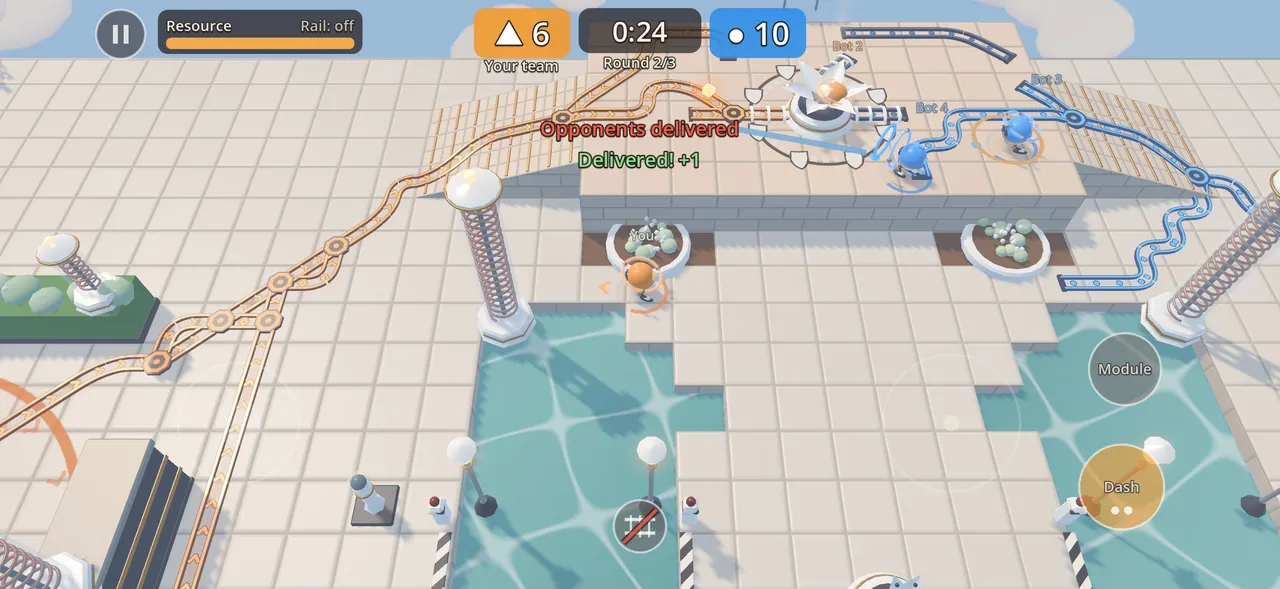
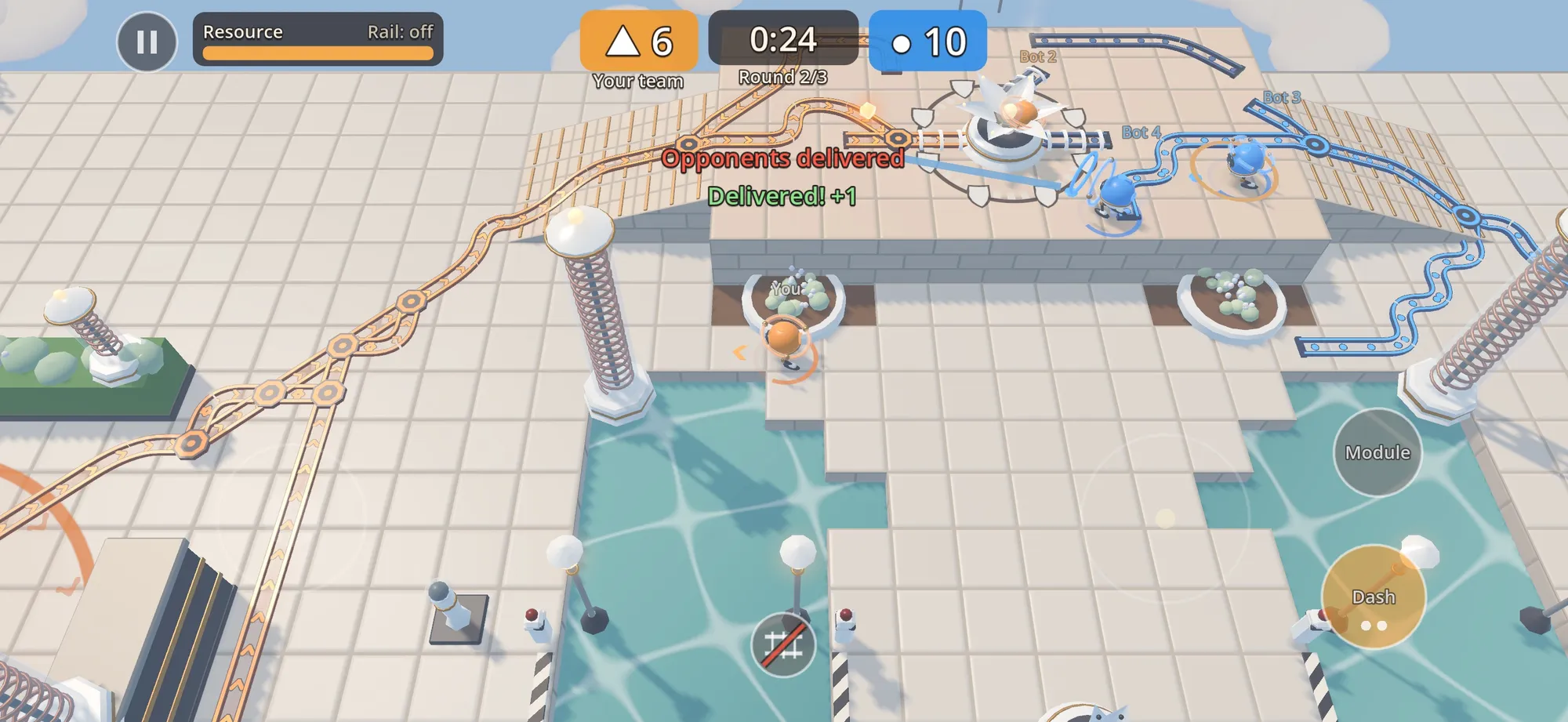
In-game screenshot · iPhone · development build, 3 Oct 2026 · botsCoil Garden, round 2: both teams’ rails reach the receiver on the terrace. “Delivered! +1” — an amber pulse just scored; “Opponents delivered” — so did Azure.Open the full frame — In-game screenshot on Coil Garden, round 2 of 3: amber and azure rails reach the receiver on a raised terrace; messages “Opponents delivered” and “Delivered! +1”; score 6 to 10.
02 / After the first +1
Keep it flowing
- 30 s
Refresh before it fades
Each piece of rail disappears 30 s after it was laid or last refreshed. Ride over your own rail with laying on to refresh it — only 0.25 per metre, and the clock restarts. For its last 3 s the game warns that it is about to fade.
- ×1.35
Ride your own rail
On your own powered rail you ride about a third faster — 7.4 m/s instead of 5.5 m/s. Enemy and unpowered rails give no boost. Riding back along the route refreshes it, too.
- 15/s
Refill faster
Low on resource? Ride your own powered rail with laying off: there the reserve refills at 15 per second instead of 10.
03 / Tips
Small things that win rounds
Shorter is faster
A shorter route costs less and each pulse arrives sooner. The challenge “Short delivery” puts it in one line:
The shortest rail is the fastest.
Glow means power
The tutorial tells you to
Ride along your glowing rail
, and a loading-screen tip adds:A broken rail goes dark
. If yours isn’t glowing, look for the missing link.Teammates count
Your team’s branches join where they meet. Link up with a teammate’s powered rail and yours is powered too — no need to start from scratch.
Practise without pressure
Tutorial steps 2 and 3 teach exactly this, and the challenge “Short delivery” asks for 3 pulses within 45 seconds. In the tutorial rails don’t fade on the usual timer — in a match they do.
VELTRAIL 1.0.0 · build 1
Where the numbers come from
Every number on this page is read from the data files of VELTRAIL 1.0 (build 1). When an update changes the balance, the page changes with it.
Last compared with the game’s files:
Show the table (17)
| What | Value | Source |
|---|---|---|
| Generator beat (one pulse per…) | 3 s | Game balance databalance.json · pulse.emission_period_s |
| Pulse speed | 8 m/s | Game balance databalance.json · pulse.speed |
| Round length | 45 s | Game balance databalance.json · match.round_s |
| Most pulses per team per round | 14 | Calculated: one pulse every 3 s, from 3 s to 42 s of a 45 s round |
| Laying resource (full reserve) | 100 units | Game balance databalance.json · rail.reserve |
| New rail, per metre | 1 per metre | Game balance databalance.json · rail.cost_new_per_m |
| Resource refill, per second | 10 per second | Game balance databalance.json · rail.regen_per_s |
| Refill starts after you stop spending | 0.8 s | Game balance databalance.json · rail.regen_delay_s |
| Refill on your own powered rail, laying off | 15 per second | Game balance databalance.json · rail.regen_on_rail_per_s |
| Life of a piece of rail | 30 s | Game balance databalance.json · rail.edge_life_s |
| Refreshing your rail, per metre | 0.25 per metre | Game balance databalance.json · rail.cost_refresh_per_m |
| Blinking before it expires | 3 s | Game balance databalance.json · rail.expiring_warn_s |
| Courier speed | 5.5 m/s | Game balance databalance.json · courier.speed |
| Speed on your own powered rail | ×1.35 | Game balance databalance.json · courier.rail_boost_mult |
| Courier speed on your own powered rail | 7.4 m/s | Calculated: courier speed 5.5 m/s × 1.35 |
| Shortest generator → receiver routes (all arenas, all rounds) | 21.43–33.79 m | Measured with the game’s own arena tool on the version 1.0 arena layouts |
| Example: Coil Garden, round 2 | 24.7 m · ≈3.1 s | Measured with the game’s own arena tool on the version 1.0 arena layouts. Calculated: route length ÷ pulse speed (8 m/s) |